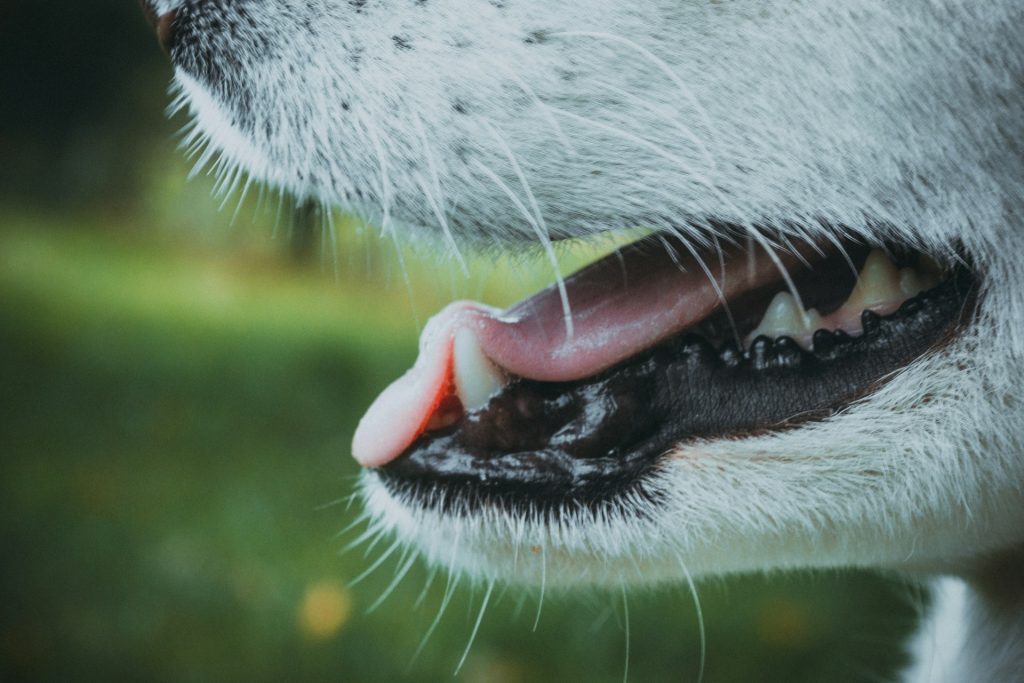
So a veterinarian has diagnosed your dog with periodontal disease and recommended a COHAT (Comprehensive Oral Health Assessment and Treatment). After the COHAT, what can you do to decrease how often the procedure needs to be done? Once your dog has had a COHAT and has been rechecked by a veterinarian to ensure the healing of the gums (gingiva), it is time for you to start a home dental care plan. At Veterinary Dental Specialists of Missouri, we frequently counsel our clients regarding home dental care for their dogs. Here are some of the recommendations we offer to our clients.
Daily Brushing
The best way to keep your dog’s teeth clean is through daily brushing. Brushing also provides the additional benefit of bonding with your dog and catching oral health conditions like fractured teeth and oral tumors earlier, improving the prognosis for the success of treatment.
The tools needed for brushing include a soft toothbrush appropriately sized for your dog’s mouth and a toothpaste designed for use in dogs. Do not use a human toothpaste since those often contain fluoride and foaming agents that can make dogs sick. Dog toothpastes contain special enzymes to help with the breakdown of plaque and are made in flavors that appeal to dogs.
The best way to start with brushing is to let your dog taste the toothpaste. Once you have a toothpaste your dog looks forward to, you can gradually start touching your dog’s lips while offering the toothpaste. Gradually work toward getting your finger and then a toothbrush under their lips. Move through the steps slowly and back up to the last step anytime your dog shows any signs of fear or anxiety. Many dogs grow to look forward to their daily brushing routine.
Dental Chews
If you are unable to brush your dog’s teeth due to physical limitations or safety concerns, there are some secondary options that can be helpful. There are many dental chews on the market to provide mechanical action along the tooth surfaces. Some even contain enzymes that can help with the breakdown of plaque. Make sure that you can press your fingernail slightly into anything you give your dog to chew. If your fingernail can’t make an impression, the chew is too hard. For more details, see our post “The Danger of Hard Chew Toys for Dogs.”
Tooth-Friendly Diet
Diet is another component of your dog’s dental health. Unless your dog requires a soft diet due to an existing health condition or physical concern, dry diets are best for dental health.
Regular over-the-counter dry diets provide mechanical action on the teeth if the dog chews on the kibble. Prescription diets for dental health are also available. These diets make use of a kibble that encourages chewing and provides extended mechanical action and cleaning of plaque from the teeth due to the way the kibble is formulated. One diet on the market also includes a compound that helps to bind calcium in the saliva to decrease mineralization of the plaque.
For proper diet selection, always consult your veterinarian about your pet’s unique health concerns.
Prescription and Non-Prescription Options
There are a variety of prescription and non-prescription options for dental home care. Prescription options (such as chlorhexidine rinses) should only be used under the supervision of a veterinarian or Board Certified Veterinary Dental Specialist®.
Non-prescription options should be evaluated carefully. One thing to look for on the packaging is a seal from the VOHC (Veterinary Oral Health Council). This indicates that the research on a product has been evaluated by the organization and found to be reliable.
If you are interested in a product you find on the market, ask your veterinarian to help you evaluate the product. Remember that part of your veterinarian’s training is in evaluating research on active ingredients and determining the quality of those studies. Just because a product says it is supported by research or even recommended by veterinarians does not always mean that the research is reliable or that the product has the benefit that is claimed. The word “natural” can also be used with minimal restrictions. Remember, many toxic products are “natural,” but that doesn’t make them healthy or beneficial. Don’t fall for the hype of advertising. Be a wise consumer and ask a professional.
Consult a Missouri Veterinary Dentist
If you have any questions or concerns about your dog’s oral health, please call your veterinarian, or give us a call at 636-695-9955 to make an appointment with a Board-Certified Veterinary Dentist®.
Images used under creative commons license – commercial use (3/18/2026). Photo by Andriyko Podilnyk on Unsplash